Here is an email from Dave dated July, 2012, with news about how well their passive solar home is doing:
Well, compared to Greenville, we certainly are cool. It is supposed to get up to a roasting 82 today, which for Maine is pretty darn warm. Without air conditioning, this house can warm up a lot in the day.
On the other hand, the house does really, really well in the winter. We never turned on
the heat last winter; we just warmed up the bathroom for showers, and burned less than half a cord of wood in the wood stove. A friend gave the wood to us in exchange for baby-sitting. Our power bill last month was $8.91. This month it went up to $9.58.
Our neighbor was so inspired by our solar system that he installed 28 photoelectric panels on his garage roof, more than twice as many as I have.
If my rock samples are not currently getting in the way, could you save them while I
think about it? I am going to be teaching a geology course at the local branch of the University of Maine, and may need some of my samples that are stored at ECU.
The Belfast branch of U Maine has almost no budget.
Now that Sally cut all her teaching ties to ECU and took a job at the Belfast Free Library, lots of people on the street in town recognize her. "Hey mom, it's the library lady!" It really is fun to be part of such a small town that you meet people you know just walking from the post office to the grocery.
This one is dated July, 2011:
Yes, we are all moved in, and the house is fun. Despite a string of cloudy days, we generated 75% of the
electricity we used, and most of the hot water. The soil here makes gardening a challenge, though. You think
the soil can be clay-rich in Greenville, you ought to see this stuff. If this were Mexico, we could build with adobe.
Time to build more raised beds.
Monday, October 8, 2012


News from Dave and Sally Lawrence
Here's an email I received from Dave Lawrence in January 2011, shortly after their move to Maine:
Our new solar home is being built by G O Logic architecture and construction. The frame
and the big insulated panels are up, so they are close to adding the metal roof, then
starting on plumbing and electrical. We will have solar hot water and PV cells on the roof.
The house will be very close to the requirements of the Passiv Haus organization in Germany.
The architect tried to get us to not put in the wood stove. He said we might get too hot.
The carpenters, Eric and Morty, are phenomenal. They keep cheerfully working in near blizzard
conditions.
So next spring we get to move in April or May, just in time to plant a wind break and a garden.
The garlic beds are already in.
This region is wild for music. Every time you turn around there are contra dances and fiddle groups.
There even is a summer fiddle camp.
Interesting: most of today it was warmer here in Maine than in Greenville.
Cheers,
Dave
Our new solar home is being built by G O Logic architecture and construction. The frame
and the big insulated panels are up, so they are close to adding the metal roof, then
starting on plumbing and electrical. We will have solar hot water and PV cells on the roof.
The house will be very close to the requirements of the Passiv Haus organization in Germany.
The architect tried to get us to not put in the wood stove. He said we might get too hot.
The carpenters, Eric and Morty, are phenomenal. They keep cheerfully working in near blizzard
conditions.
So next spring we get to move in April or May, just in time to plant a wind break and a garden.
The garlic beds are already in.
This region is wild for music. Every time you turn around there are contra dances and fiddle groups.
There even is a summer fiddle camp.
Interesting: most of today it was warmer here in Maine than in Greenville.
Cheers,
Dave
Wednesday, May 6, 2009
A Kolt Update
After reading the latest Alumni Newsletter, I was reminded how great it was to be a part of ECU Geology. I’m sad to say that I won’t make this year’s Pig Pickin’, so will have to pass on a few updates via the interweb.
This past summer has been very busy with a host of projects, a drought, and lots of extra-curricular activities. Recent issues surrounding water allocation in Hawke’s Bay have highlighted the need for updated information on fundamental catchment hydrology. One of our projects this year has been a concurrent gauging program in the Ruataniwha Plains. This involves 36 sites on 5 river systems, all gauged for flow at the same time. Irrigation bans were also imposed to allow the catchments to equalize before gauging to ensure that natural conditions were measured – not an easy pill to swallow for farmers during a drought! We have since pushed through the hard times and the results are looking good.

Micheal Taylor gauging the Maharakeke Stream in the Ruataniwha Plains
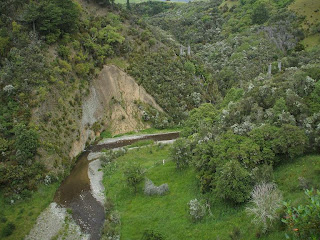
The Mangatewai Stream at the base of the Ruahine Ranges


This past summer has been very busy with a host of projects, a drought, and lots of extra-curricular activities. Recent issues surrounding water allocation in Hawke’s Bay have highlighted the need for updated information on fundamental catchment hydrology. One of our projects this year has been a concurrent gauging program in the Ruataniwha Plains. This involves 36 sites on 5 river systems, all gauged for flow at the same time. Irrigation bans were also imposed to allow the catchments to equalize before gauging to ensure that natural conditions were measured – not an easy pill to swallow for farmers during a drought! We have since pushed through the hard times and the results are looking good.

Micheal Taylor gauging the Maharakeke Stream in the Ruataniwha Plains

The Mangatewai Stream at the base of the Ruahine Ranges
Work on the Tutaekuri River has also kept me busy. This is a continuation of last year’s survey on habitat-flow relationships. A lot of meticulous measurements afield have led to successful modeling back in the office. This project will end soon and the results will be fed into the flow-setting process, which will ultimately provide a sound basis for water management in this catchment.

Walking the Tutaekuri River during a habitat mapping exercise

Walking the Tutaekuri River during a habitat mapping exercise
In other news, this past summer provided some amazing underwater experiences. The Extreme Freedom divers went near and far and pulled up a few denizens from the deep. Highlights are hard to separate from the ordinary – it’s just too good here! There are a few notable things to mention – Me and Nick Williams teamed up for both the North Island and NZ National Spearfishing Championships and earned respectable 7th and 13th place finishes, respectively. I’ve also taken to hunting with a polespear – the most primitive form of spearfishing. It really tests the skills of an underwater hunter and has given me some great memories. I’m currently developing a polespear for the NZ market. Finally, I’ve been documenting my adventures and sharing them with the rest of the world through the magazines NZ Spearo and Hawaii Skin Diver. If you ever see one on the shelf, grab a copy!

23kg yellowtail kingfish by polespear

23kg yellowtail kingfish by polespear

Another polespeared yellowtail kingfish on a rough day

My best wishes go out to ECU Geology and the faculty, staff, and students. I’ll have to book my flights for Pig Pickin’ 2010!

No hydrologist is complete without a fly rod...Tukutuki River rainbows agree!

No hydrologist is complete without a fly rod...Tukutuki River rainbows agree!
Monday, May 5, 2008
Pigs and Dogs, Oysters and Music, Water and Sun ... and Friends
 Steamed Oysters, barbequed pork, Richard at the helm.
This past Saturday, May 3rd, 2008, marked the annual ECU Geology Barbeque at the Ranch. If you made it to the event, I don't have to tell you how much fun it was. These things are family reunions. If you missed it ... well, I'm really sorry for you.
 The Old Farts Club held several impromptu meetings.
This year the Department is celebrating its 40th anniversary. Started way back when by Dr. C.Q. Brown, and staffed by Drs. Stan Riggs, Mike O'Connor, and Jean Lowery. C.Q. was at the party on Saturday; Stan was there; and, I know that Jean was there in spirit. Jeff Brame flew in from Durango, CO. Jeff was a member of the founding class (and spoke of a recent sighting of Mike O'Connor). Scott Hartness was there, another member of the founding class. Bill Crew was there; I'm not sure if Bill was in the founding class, but if not, he only missed by a week or two. (I, on the other hand, like to remind myself whenever I'm feeling old, that when C.Q. and Stan were starting the department, and the guys mentioned above were playing "Rat Patrol" with departmental vehicles over the dunes on the NC Outer Banks, *I* was 8-years-old and riding my new "banana bike" to cub scout meetings. Heh heh ... bunch'o old farts, those guys are!)
 "The Revelators"
A bazillion thanks are due to Lisa and Richard, for once again offering their place and their gracious hospitality as hosts for this event. Nearly as many thanks are due to "The Revelators" for providing live music throughout the day. But most important, without a doubt, are the faculty and current students who ARE the ECU Department of Geological Sciences. These are the folks who make it happen. These are the folks who keep it going. The are the folks who make me proud to be an East Carolina geologist, a member of the alumni.

Marshmallows and Beer
So now ... How about a little game? You may have seen me making photographs on Saturday, and I've posted a few here. I think there were quite a few "nice 'uns" in the bag; far too many to post here on this blog page. So, what I've done is to post them on a web gallery. You can get there by clicking this LINK. "So what's the game", you might ask? Glad you did. When you go to that web photo gallery, YOU get to test your recognition and departmental history skills by identifying the most people in the most photos. The winner on each photo is the one who first leaves a comment with everyone correctly identified. Remember, spelling counts. The overall winner is the one who wins on the most individual photographs. I will select what I think is the best caption suggestion, or you all can vote for those previously posted. You don't have to leave your full name in the comment - though you can - but we'll need some way to identify you if you want to be a contender.
Again, the link to the web gallery is HERE.
Have fun. And thanks again to everyone for an excellent day last Saturday!
Wednesday, April 9, 2008
NZ Update
Glad to be on board! I figured that describing some of the work I've been involved in lately would be a good addition to the fish stories!
For those that don't know, I'm the Surface Water Quantity Scientist at Hawke's Bay Regional Council, in Napier, New Zealand. The Regional Councils are charged with the sustainable management of New Zealand's natural and cultural resources. I direct the science programs that deal with surface water resources in our region, which provide the necessary data for sustainable water management.


Hawke's Bay has a very similar climate to North Carolina, including it's susceptibility to very low streamflows in the the summer. Agricultural intensification and it's increasing irrigation demand is a direct stress on the Hawke's Bay rivers. Low-flows keep me busy!
The latest project I have been involved in is on the Tutaekuri River, modeling habitat availability for native and introduced fish species and invertebrates. The results of which will be used alongside economic and cultural values to set a minimum flow and allocable abstraction volume for the upper reaches of the Tutaekuri.


No good story is complete without a fish tale, so here's the latest.
My birthday was last weekend, so after my trip to the South Island for some modeling work and a workshop (tough job, I know), I was dying to go diving to try out the two new spearguns that I just finished. After a furious round of texting, I was able to put a trip together to dive Kapiti Island, north of Wellington.
The new guns performed awesomely and I was able to bring home some really nice blue moki, red goatfish, and terakihi (not pictured). The day was beautiful with relatively calm seas and just a little rain to keep things interesting. On the way back from Kapiti, I got a call from some other spearos, saying that I needed to hurry up and meet them for a bluewater trip off Mt. Taranaki, one of the more famous spots in New Zealand. I got home at 10pm, left the house at 12:30am and met up with the guys for the drive to New Plymouth. We were at the boat ramp before dawn and headed out into the open ocean. To make a long story short, we didn't get any fish, but the purple-blue water and incredible backdrop made it worth wile!


For those that don't know, I'm the Surface Water Quantity Scientist at Hawke's Bay Regional Council, in Napier, New Zealand. The Regional Councils are charged with the sustainable management of New Zealand's natural and cultural resources. I direct the science programs that deal with surface water resources in our region, which provide the necessary data for sustainable water management.
Hawke's Bay has a very similar climate to North Carolina, including it's susceptibility to very low streamflows in the the summer. Agricultural intensification and it's increasing irrigation demand is a direct stress on the Hawke's Bay rivers. Low-flows keep me busy!
The latest project I have been involved in is on the Tutaekuri River, modeling habitat availability for native and introduced fish species and invertebrates. The results of which will be used alongside economic and cultural values to set a minimum flow and allocable abstraction volume for the upper reaches of the Tutaekuri.
No good story is complete without a fish tale, so here's the latest.
My birthday was last weekend, so after my trip to the South Island for some modeling work and a workshop (tough job, I know), I was dying to go diving to try out the two new spearguns that I just finished. After a furious round of texting, I was able to put a trip together to dive Kapiti Island, north of Wellington.
The new guns performed awesomely and I was able to bring home some really nice blue moki, red goatfish, and terakihi (not pictured). The day was beautiful with relatively calm seas and just a little rain to keep things interesting. On the way back from Kapiti, I got a call from some other spearos, saying that I needed to hurry up and meet them for a bluewater trip off Mt. Taranaki, one of the more famous spots in New Zealand. I got home at 10pm, left the house at 12:30am and met up with the guys for the drive to New Plymouth. We were at the boat ramp before dawn and headed out into the open ocean. To make a long story short, we didn't get any fish, but the purple-blue water and incredible backdrop made it worth wile!


Wednesday, March 5, 2008
Kolt in New Zealand
Here's an email I received from Kolt along with some pics from New Zealand:
 One of the most magical places in the world is located northeast of Auckland, New Zealand, off of the Coromandel Penninsula. Great Barrier Island and outer islands like the Mokohinaus are simply a diver's dream.The Hawke's Bay Freedom Divers organized a GBI trip this past weekend and it was spectacular. We "hooked" up with a local named Alfie, who we just called The Pirate. As rough as a sailor and nice as can be. He let us stay in his "new" guest house - an old caravan with added roof and bunk area. Highlights of the trip were going to The Needles and shooting a monster yellowtail kingfish and taking pictures of all kinds of sea life, then heading to the Mokohinaus and getting some beautiful, elusive, and extra tasty pink maomao, while swimming with penguins, then getting to swim with wild dolphins at Wellington Head, GBI. A trip for the record books.Kolt

 One of the most magical places in the world is located northeast of Auckland, New Zealand, off of the Coromandel Penninsula. Great Barrier Island and outer islands like the Mokohinaus are simply a diver's dream.The Hawke's Bay Freedom Divers organized a GBI trip this past weekend and it was spectacular. We "hooked" up with a local named Alfie, who we just called The Pirate. As rough as a sailor and nice as can be. He let us stay in his "new" guest house - an old caravan with added roof and bunk area. Highlights of the trip were going to The Needles and shooting a monster yellowtail kingfish and taking pictures of all kinds of sea life, then heading to the Mokohinaus and getting some beautiful, elusive, and extra tasty pink maomao, while swimming with penguins, then getting to swim with wild dolphins at Wellington Head, GBI. A trip for the record books.Kolt
Kolt Johnson, Pete Parham
 Kolt Johnson (MS, 2007) is one of the more adventureous students to come along in a while. He has a strong interest in spearfishing while freediving. While here, he brought back lots of good fish from his expeditions off the North Carolina coast, and got Pete Parham involved as well. Pete was with us during the late 1980's, and is now back working on a PhD involving the NC pleistocene. Pete will be presenting some of his work to the department at a seminar on Friday.
After getting his MS, Kolt managed to land a job in New Zealand, where he is now living.
Here are a couple of pictures Kolt and Pete on some of their spearfishing expeditions off the NC coast. Kolt tells me they were spearing fish at 70 feet without SCUBA. Top pic is of Kolt among a school of Amberjack. Below, we see Pete with an African Pompano he has just landed the same way.

Thursday, February 28, 2008
Walter Hale
Walter Hale (MS, 1985) dropped by the department a few weeks ago. Walter has been managing the Ocean Drilling Program core repository in Bremen, Germany for many years since leaving the oil patch in New Orleans in the 1980's. Interesting to hear his perspective on the US of A from the other side of the pond. Walter regularly receives international dignataries who are interested in his facility. One recent visitor was the son of Fidel Castro, who evidently is a scientist, and has a prominent position in Cuba's science beaurocracy.
I'd like to invite one and all to contribute to our ECU Geology alumni blog by emailing your submissions to me. I will copy/paste your text and pictures into the blog. And let me know if you'd like to become a regular contributor. Pat and I will be happy to send you a password so you can contribute on your own.
I'd like to invite one and all to contribute to our ECU Geology alumni blog by emailing your submissions to me. I will copy/paste your text and pictures into the blog. And let me know if you'd like to become a regular contributor. Pat and I will be happy to send you a password so you can contribute on your own.
Saturday, September 29, 2007
Call for contributors
Lately, it seems I have to start each post with an apology, because it has been too long since the last one. Work and life conspire to prevent full-time blogging. Besides, the last thing this page needs is a personal stream-of-consciousness coming from a single alumnus (me) working in one portion of the geologic community (gold exploration and mining).
So, I have an idea (as scary as that may be). *We* need a few people who'd like to write for this page. There are no minimum number of posts per week/month required. No credentials other than being an alumus or affiliated with the ECU Geology Department in some way. Pay is commensurate with requirements. Jim Watson is in to represent departmental news and happenings. If you'd like to take a shot at a post or two, give me a shout at patrick.mallette [a-t] newmont.com; I'll set you up. (If you can't figure out my email address from the way I wrote it - hopefully to foil spam bots - well, I guess I won't hear from you.)
I am at home, on a break from Mexico field work, and had the pleasure to attend Geology's Friday Noon Seminar yesterday. Dr. David "Spike" Mallinson and Dr. J.P. Walsh gave talks on their respective backgrounds and past and current research. I sat in the audience, asked a few unintelligible questions, didn't get thrown out, and had a great time hanging out once again, after all these years, in Graham #309 for some stimulating geological discussions. Stan Riggs, Steve Culver, Jim Watson, Dick Mauger, Dave Lawerence, Mike O'Driscoll, students ... the gang is alive and doing very well. If you get a chance to stop by Graham building one Friday, do it!
You'll find a schedule for the Friday Seminar Series here on the department's web site.
So, I have an idea (as scary as that may be). *We* need a few people who'd like to write for this page. There are no minimum number of posts per week/month required. No credentials other than being an alumus or affiliated with the ECU Geology Department in some way. Pay is commensurate with requirements. Jim Watson is in to represent departmental news and happenings. If you'd like to take a shot at a post or two, give me a shout at patrick.mallette [a-t] newmont.com; I'll set you up. (If you can't figure out my email address from the way I wrote it - hopefully to foil spam bots - well, I guess I won't hear from you.)
I am at home, on a break from Mexico field work, and had the pleasure to attend Geology's Friday Noon Seminar yesterday. Dr. David "Spike" Mallinson and Dr. J.P. Walsh gave talks on their respective backgrounds and past and current research. I sat in the audience, asked a few unintelligible questions, didn't get thrown out, and had a great time hanging out once again, after all these years, in Graham #309 for some stimulating geological discussions. Stan Riggs, Steve Culver, Jim Watson, Dick Mauger, Dave Lawerence, Mike O'Driscoll, students ... the gang is alive and doing very well. If you get a chance to stop by Graham building one Friday, do it!
You'll find a schedule for the Friday Seminar Series here on the department's web site.
Tuesday, August 7, 2007
A long way down with no way out

For those of you who have spent some time underground - whether in a cave, or in a mine - you know that you can never experience more complete blackness than when you turn off your lamp. Your eyes strain to pick up one stray photon ... but there are none. It is a strange uncommon sensation.
As I write this, there are 6 men underground in a Utah coal mine who may be experiencing that same blackness. If so, that's a good thing, because it means they're alive. Yesterday there was a cave-in at the Crandall Canyon coal mine; it happened at the same time that a moderate earthquake was registerd in the area. Right now there seems to be an argument as to whether the cave-in was responsible for the seismic shock, or an earthquake resulted in the mine collapse. For the six men down below, the answer to that is the least of their worries.
Rescue workers at the surface estimate it will be three more days before they can reach the area where the men are thought to be. Five days (total) is a loooong time to be alone in the dark, with nothing to do but wait and think.
About all any of us can do is to remember that these and other miners put their lives at risk every day to give us - individuals and society - the raw materials to live comfortably and prosper. Think about these coal miners and their families next time you flip the switch on a light or an appliance.
Thanks guys. We're cheering for you.
Tuesday, July 10, 2007
And speaking of caves ...
 Photo copyright Javier Trueba (Madrid Scientific Films)/Geology
 It's been a while since we've seen a post on these pages. Apologies ... but the "day job" has been calling loudly as of late.
Anyway, the last post on Dr. Jean Lowry got me thinking about caves. In particular the Cueva de Cristales (Crystal Cave) located in Chihuahua, Mexico. Take a look at the photo above. Yes, that is a full-grown human man standing atop a selenite crystal. No photoshop. I had the priveledge of visiting the Cueva de Cristales myself last year. I'm usually not one to pick favorites, but I think I can safely say that this was the most impressive, fantastic, breathtaking, awe-inspiring natural wonders I've ever seen in my life.
The Cueva de Cristales is located 1200 feet underground, near the town of Naica, in Chihuahua state, Mexico. In April 2000, Javier and Eloy Delgado discovered the adjacent Cave of Swords during mining of Industrias Peñoles Naica lead-zinc-silver mine. One month later, another group of miners broke into the Cueva de Cristales. Crystals in both caves have been designated as the largest ever encountered anywhere in the world. Individual crystals are up to 4 feet in diameter and 50 feet long.
After traveling from the surface down through the blackness to the level of the Cueva de Cristales, we came to a locked steel door guarding the entrance. The temperature in the mine was warm, but fairly comfortable. The door was unlocked and we climbed a short flight of steps; immediately in front were plexiglas panels sealing the cave from the ambient environment of the mine. The panels were fogged but it was apparent that something hugely spectacular lay behind. The plexiglas door was then opened and we stepped inside to an air temperature of 150 degrees farenheit and 100% humidity. The experience defined "shock and awe" as one's mind did somersaults trying to make sense of the scale, and the body's alarms went to full red alert due to the heat and humidity. You only get about 5 or 6 minutes inside ... any longer and they'd be dragging you out unconscious. Photography was next to impossible for us "tourists" as water vapor would condense instantly on any glass surface. The photograph above was made by a team of professional photographers using preheated cameras and wearing water-cooled suits that allowed them extra time inside the cave.
¡Fantastico!
Saturday, June 9, 2007
Dr. Jean Lowry - Pioneer
 Jean Lowry, a founder of the Wytheville Grotto, in Nebo Cave. Photo by Wayne Whitt.
In the comments section of an earlier post, Scott H suggested a link to a web site that references Dr. Jean Lowry's participation in the "Wytheville Grotto", a spelunking club that operated in spectacular caving country of western Virginia from 1950-1958. The article is from a tape recorded interview Jean gave in which she talked about her introduction to spelunking, adventures and mishaps in Virginia caves, and the founding of the Wytheville Grotto "organization".
Jean pioneered cave exploration and mapping in the Wytheville, VA, area prior to her teaching career - first in the Geography Department, and later as the first faculty member in the newly formed Geology Department - at East Carolina University.
In the mid-1900's, women were not supposed to study geology at Yale; women were not supposed to crawl through the mud and muck of caves by night, and then show up for work the following morning at the Virginia Geological Survey.
But Jean did. The word "conventional" was never part of her vocabulary.
In case you missed it, or in case you would like to read it again, S. Snyder wrote a very nice piece on Dr. Jean Lowry in the 2004 Alumni Newsletter, following her death on November 16, 2003. You can find Scott's tribute here, if you scroll down to the third article.
It is impossible for a group of ECU geology alums from the late '60s to early '80s to get together and not share laughs and smiles over Jean Lowry stories and tales. People such as Jean inspire us and enrich our lives.
That we all might be so lucky as to be remembered so fondly.
(Thanks to J. Watson for the link to the Wytheville Grotto article!!)
Monday, June 4, 2007
On Shaky Ground in New Hampshire?

The folks in New Hampshire were treated to a couple of earthquakes over the past weekend. I say "treated" because I actually like to feel the earth rumble. Not too much, mind you; just enough to remind me of the processes taking place within the earth's crust. It is not only naive to forget the earth's dynamics, and how geologically instantaneous events contribute much of what we observe in the geologic record, it can be very dangerous and costly.
Last weekend's events in New Hampshire were small - magnitude 1.4 and 1.9 - and many people probably didn't even notice them. A magnitude 5.5 quake that rocked the area in 1940 likely drew a bit more attention. Historic earthquakes have been recorded as far back as 1663.
The eastern passive margin of North America doesn't compete with the western active margin in terms of earthquake frequency. Still, those on the east coast get to feel the ground shake occasionally. I've felt quite a few mild earthquakes having lived and worked in places like Nevada, California, Montana, and in the Andes of Peru, but the first quake I experienced occurred in Raleigh, NC. And then there was that magnitude 7.3 rock-n-roller that caught the attention of Charleston, SC, in 1886.
I can't claim to have experienced any large, or even moderate, quakes. Probably magnitude 3 ... maybe 4 ... max. I felt the 1989 earthquake that hit San Francisco and interrupted the World Series. I was at the office in Reno, Nevada.
Who has their own memorable earthquake experience? Post 'em in the comments below!
Friday, June 1, 2007
You've been challenged!
Down in the comments section of our first blog post I found this from Scott H:
"I will donate $1 to the ECU Geology Century fund for each legit new alumnus or current grad student who posts a comment for the month of June! How's that for an incentive?"
Consider yourselves challenged! Hmmm ... maybe that didn't come out quite right. How about "How to Make a Donation to the ECU Geology Century Fund While Using Scott's Money". Yeah, that sounds better. And all you have to do is leave a comment - what the heck, leave multiple comments, we'll get some discussion going - on any of the posts you find here in the month of June. Schweeeet.
Of course, we will also consider accepting your money as well as Scott's. Both are considered legal tender here. If you haven't done so yet, or don't know how, contact Dare or Steve in the Geology office. Or, leave a comment - thereby spending some of Scott's money ... heh heh - and we'll contact you.
I'll put together a post soon to let you know in detail how these donations are used. It really is for a good cause, folks. Remember when you were a starving student trying to get a leg up?
A leg up ... maybe I'll just stop right here.
"I will donate $1 to the ECU Geology Century fund for each legit new alumnus or current grad student who posts a comment for the month of June! How's that for an incentive?"
Consider yourselves challenged! Hmmm ... maybe that didn't come out quite right. How about "How to Make a Donation to the ECU Geology Century Fund While Using Scott's Money". Yeah, that sounds better. And all you have to do is leave a comment - what the heck, leave multiple comments, we'll get some discussion going - on any of the posts you find here in the month of June. Schweeeet.
Of course, we will also consider accepting your money as well as Scott's. Both are considered legal tender here. If you haven't done so yet, or don't know how, contact Dare or Steve in the Geology office. Or, leave a comment - thereby spending some of Scott's money ... heh heh - and we'll contact you.
I'll put together a post soon to let you know in detail how these donations are used. It really is for a good cause, folks. Remember when you were a starving student trying to get a leg up?
A leg up ... maybe I'll just stop right here.
Thursday, May 31, 2007
Like a Hurricane
 Low tide on the beach at Corolla, NC (photo © P. Mallette)
"If we had a Katrina-sized storm, 75 percent of these islands could be gone," says Stan Riggs, a geologist at East Carolina University who has studied the Outer Banks for four decades. "You can count on it cleaning the clock."
A series of stories on hurricane hazards appeared on the news wires recently. Interesting reading, though these stories hardly qualify as "news" to ECU geology alums who cut their teeth on this stuff, or to the current faculty and students who continue the tradition of trying to educate the public on the folly of building mega-dollar homes on mobile ribbons of sand.
Stan Riggs is quoted in the story by AP writer Mike Baker - "THE OUTER BANKS: '75 percent of these islands could be gone'". Scroll down ... you'll find it toward the bottom of the page.
[Edit: The link to the story was corrected on 1-June. --Pat]
Wednesday, May 30, 2007
Minutes from the May 4th GAC meeting
Notes from the Fourth ECU Geological Sciences Advancement Council Meeting
May 4, 2006
Present: Steve Culver (Chair), Scott Snyder, Scott Hartness, Pat Mallette, Steve Benton, Ron Crowson, Jim Watson also attended at Culver's request.
Absent: Mike Amsbaugh, Brent Chambers, C.Q. Brown, Jerry Dominey, Wink Winkler, Lynn Sutton
1. Culver called the meeting to order and welcomed the alumni.
2. Culver reviewed action points from the third GAC meeting. Watson contributed information re web site development activities.
3. Hartness and Crowson reported on past activities of the Geological Alumni Society (GAS) and led discussion of future plans.
4. Wide-ranging discussion occurred on fund-raising efforts, past and present.
5. The following action plan was agreed to.
a) Crowson and Mallette will meet in the next few weeks to design and construct a GAS web site or blog.
b) Old slides/images are to be forwarded to Culver who will organize scanning and storage on a departmental server. Selected images will be rotated onto the departmental web site and GAS web site/blog.
c) Names of potential new Alumni Council members will be forwarded to Culver by end of May, 2007.
d) The president of Sigma Gamma Epsilon will be invited to future GAC meetings.
e) Hartness and Crowson to organize funding of the Jean Lowry plaques immediately upon receipt of the final quote from Jim Watson.
f) Culver to provide the contact information of all alumni donors over the past three years to Hartness. Hartness, Crowson, Mallette and Benton will call the donors to thank them and to ask them to consider organizing regular donations and estate planning to include the Department of Geological Sciences.
g) Culver will ensure that the 2008 departmental newsletter will include information on estate planning.
Following business, the meeting was adjourned, and all made their way to Richard Spruill's front 40 to celebrate the recent geology graduates with friends and families, fine eastern NC BBQ, and golden beverages.
May 4, 2006
Present: Steve Culver (Chair), Scott Snyder, Scott Hartness, Pat Mallette, Steve Benton, Ron Crowson, Jim Watson also attended at Culver's request.
Absent: Mike Amsbaugh, Brent Chambers, C.Q. Brown, Jerry Dominey, Wink Winkler, Lynn Sutton
1. Culver called the meeting to order and welcomed the alumni.
2. Culver reviewed action points from the third GAC meeting. Watson contributed information re web site development activities.
3. Hartness and Crowson reported on past activities of the Geological Alumni Society (GAS) and led discussion of future plans.
4. Wide-ranging discussion occurred on fund-raising efforts, past and present.
5. The following action plan was agreed to.
a) Crowson and Mallette will meet in the next few weeks to design and construct a GAS web site or blog.
b) Old slides/images are to be forwarded to Culver who will organize scanning and storage on a departmental server. Selected images will be rotated onto the departmental web site and GAS web site/blog.
c) Names of potential new Alumni Council members will be forwarded to Culver by end of May, 2007.
d) The president of Sigma Gamma Epsilon will be invited to future GAC meetings.
e) Hartness and Crowson to organize funding of the Jean Lowry plaques immediately upon receipt of the final quote from Jim Watson.
f) Culver to provide the contact information of all alumni donors over the past three years to Hartness. Hartness, Crowson, Mallette and Benton will call the donors to thank them and to ask them to consider organizing regular donations and estate planning to include the Department of Geological Sciences.
g) Culver will ensure that the 2008 departmental newsletter will include information on estate planning.
Following business, the meeting was adjourned, and all made their way to Richard Spruill's front 40 to celebrate the recent geology graduates with friends and families, fine eastern NC BBQ, and golden beverages.
Monday, May 28, 2007
The Graying of the Guard
During a recent conference in Miami, held by the Latin American Mining Congress, a middle-aged speaker began her presentation by asking the crowd, "Do you remember when we were the youngest people in the mining industry?" After a pause, she answered her own question: "Well ... we still are!"
Today, there is very little young talent entering the mining and exploration business from US schools. The will be a shortage of highly trained geologists to fill leadership roles in US- and Canadian-based companies in the near future.
Most of the young geologists that I work with these days speak spanish ... as their native language.
The problem is not restricted to the United States. Australia is feeling a similar pinch, as outlined in this story by Gregory Webb at OnlineOpinion.com.au.
Today, there is very little young talent entering the mining and exploration business from US schools. The will be a shortage of highly trained geologists to fill leadership roles in US- and Canadian-based companies in the near future.
Most of the young geologists that I work with these days speak spanish ... as their native language.
The problem is not restricted to the United States. Australia is feeling a similar pinch, as outlined in this story by Gregory Webb at OnlineOpinion.com.au.
Sunday, May 27, 2007
Old Timers' Club
 left to right: Ron Crowson, Steve Benton, Jim Watson, Pat Mallette; 2004.
If the first post to a new blog is not the hardest ... well, I guess that would mean that we are in for minimal content here.
It is time to push forward ... to gain momentum.
We - the members of ECU's Geology Alumni Society (GAS) - have been looking for ways to communicate with you - the alumni of the ECU Department of Geological Sciences (yes, the department has a new name). During our annual GAS meeting in early May, Pat Mallette suggested that we create a blog page ... "It's easy! It's cheap! Everyone can participate!", he said. So, following thatdumb comment flash idea, I am here working on this first post.
Where we go with this blog is anyone's guess. Honestly, if it flies, it will be everyone's guess ... everyone's ideas. I'll look to you for feedback and suggestions. And, I'll be very generous with handing out administrator privileges ... if you'd like to share theduty fun of posting here.
It is time to push forward ... to gain momentum.
We - the members of ECU's Geology Alumni Society (GAS) - have been looking for ways to communicate with you - the alumni of the ECU Department of Geological Sciences (yes, the department has a new name). During our annual GAS meeting in early May, Pat Mallette suggested that we create a blog page ... "It's easy! It's cheap! Everyone can participate!", he said. So, following that
Where we go with this blog is anyone's guess. Honestly, if it flies, it will be everyone's guess ... everyone's ideas. I'll look to you for feedback and suggestions. And, I'll be very generous with handing out administrator privileges ... if you'd like to share the
Subscribe to:
Posts (Atom)